

2026 Best Baby Food Pouch Suppliers for Global Buyers

Choosing the right Baby food pouch supplier in 2026 requires more than comparing prices. Global buyers must examine safety, materials, filling quality, traceability, and delivery performance. A pouch may look attractive on a sample table, yet fail during transport, heat processing, or repeated handling.

Dr. Marion Nestle, a respected nutrition and food-policy expert, has said, “Eat less, move more, eat lots of fruits and vegetables.” Her guidance reminds buyers that packaging supports nutrition, but never replaces it. A reliable supplier should protect product quality without encouraging careless feeding habits.

This guide reviews leading suppliers for international purchasing teams. It considers spout design, multilayer films, retort resistance, leak prevention, cap security, and printing accuracy. It also examines factory audits, food-contact testing, traceability systems, minimum order quantities, and production lead times. These details matter when containers cross oceans and face changing temperatures.

Some suppliers offer impressive technology. Others provide stronger customer support. Few excel at everything. A low unit price may conceal high tooling costs or slow replacement service. That deserves attention.

Buyers should request current test reports and realistic samples. They should also verify compliance with destination-market requirements before signing contracts. Supplier rankings can guide decisions, but they cannot replace technical review. Even experienced procurement teams make mistakes when they trust polished catalogs too quickly.

The best Baby food pouch partner combines dependable manufacturing, transparent communication, and practical knowledge of infant-product packaging. This article provides a careful starting point for that evaluation.
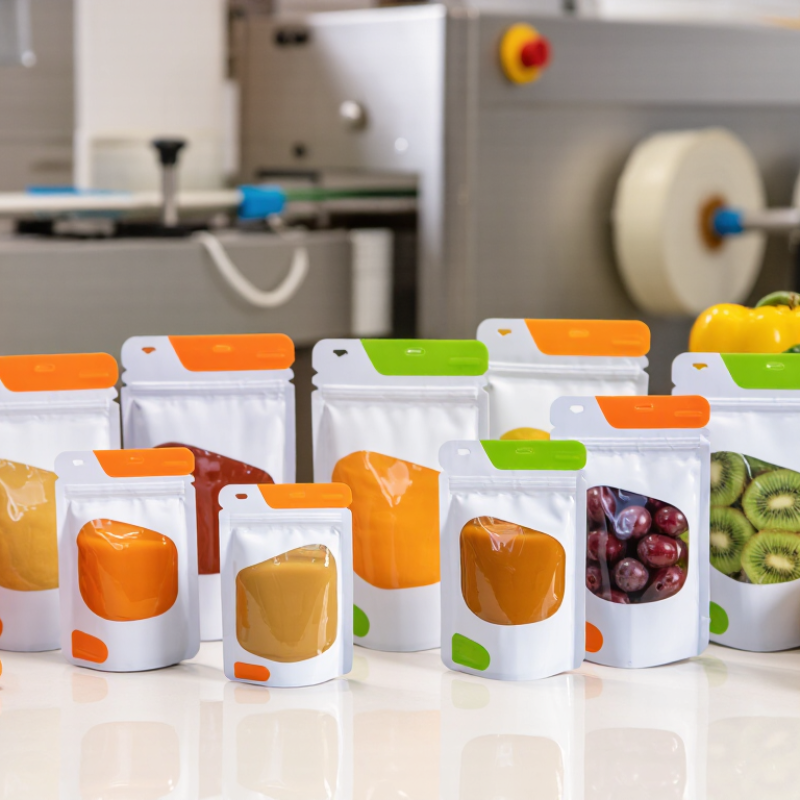
2026 Best Baby Food Pouch Suppliers for Global Buyers

Global Baby Food Pouch Market Size and CAGR Forecast for 2026

The global baby food pouch market is entering 2026 with steady expansion. Current commercial estimates place its value near USD 4 billion, depending on market definitions. Forecasts commonly indicate a compound annual growth rate of about 6% to 8% through the next several years. Numbers need context. Some reports include spouted pouches, while others count only finished baby food packaging.

Growth is supported by urban lifestyles, convenient feeding, and rising demand for portion-controlled products. Parents often prefer lightweight packs with resealable caps and clear nutrition information. Suppliers serving global buyers must provide stable film quality, accurate filling, and reliable seal performance. Their facilities should also support documented hygiene controls, traceability, and migration testing for food-contact materials. These details can matter more than a low quotation.

Regional demand will not move evenly. Asia-Pacific may see strong volume growth, while mature markets may prioritize recyclable structures and stricter packaging documentation. Buyers should compare minimum order quantities, lead times, testing records, and equipment compatibility before signing contracts. A forecast is not a promise. Exchange rates, birth-rate changes, transport costs, and new packaging rules can alter the outlook quickly. I would treat the 2026 CAGR range as a planning guide, not a guaranteed result. That uncertainty deserves more attention.

2026 Best Baby Food Pouch Suppliers for Global Buyers

Global Baby Food Pouch Market Size and CAGR Forecast (2024–2030)

This illustrative scenario uses a 2024 base estimate of USD 7.0 billion and an assumed 6.5% annual growth rate, implying a 2026 value of about USD 7.9 billion. Forecast values are calculated from these assumptions, not audited market totals; published estimates may vary with market definitions and research methodology.

Supplier Compliance with FDA 21 CFR 117, EU Rules, and BRCGS

2026 Best Baby Food Pouch Suppliers for Global Buyers

Reliable baby food pouch suppliers treat compliance as a daily production discipline. Under FDA 21 CFR 117, facilities need documented hazard analysis, preventive controls, sanitation procedures, and trained personnel. Their food safety plans should identify biological, chemical, and physical hazards linked to each pouch and filling step. Records should show who checked temperatures, seals, metal detection, and corrective actions.

EU-facing suppliers must also follow applicable hygiene, traceability, labeling, contaminant, and infant-food requirements. Ask for lot-level records, ingredient specifications, allergen controls, and evidence of microbiological testing. A useful traceability test should connect one finished pouch to its ingredients, packaging film, production date, and distribution record within hours. Check packaging migration data too. It is often overlooked.

BRCGS certification can strengthen supplier evaluation, but a certificate is not proof of perfect performance. Review its scope, site, product category, audit status, and unresolved findings. Request recent mock-recall results and verification records for cleaning and environmental monitoring. Small details matter. A loose seal can damage an otherwise strong compliance system. Experienced buyers should also confirm change-control procedures before approving new ingredients, co-packers, or packaging materials. No audit is complete forever. Even strong suppliers may leave gaps when records become routine, staff changes occur, or export rules are updated. Regular remote reviews and site audits provide a more realistic picture.

Comparing 90–200 g Pouch Formats, Fill Volumes, and Shelf Life

For global buyers, pouch size affects more than shelf space. A 90 g pouch can suit early portions or travel, while 120–150 g formats offer room for larger servings. Pouches near 200 g may fit older children, but can be harder for small hands to control. Check the filled pouch’s width, spout position, and grip when testing samples. A neat specification sheet does not show how a pouch feels at a busy breakfast table.

Fill volume should match the product’s texture and intended serving. Thick purées may need a wider spout; finely blended foods can flow differently. Ask suppliers for nominal fill, permitted variation, and headspace details, then compare actual filled units from a pilot run. Small differences matter. Shelf life depends on the recipe, heat treatment, seal quality, and packaging barrier—not pouch size alone. Request documented shelf-life data and confirm storage conditions before setting a buying plan. For longer distribution routes, assess samples after realistic temperature changes and check for leaks, swelling, color shifts, or separation. A pouch can look fine at dispatch and disappoint later. No single format is best for every market, and that is worth admitting before committing to a large order.

Evaluating MOQ, Lead Times, Capacity, and Export Coverage

Choosing the best baby food pouch supplier in 2026 requires more than comparing unit prices. MOQ, lead time, production capacity, and export coverage can affect every shipment. In supplier reviews, I examine recent purchase records, factory processes, and documented quality controls. A practical MOQ should match your launch volume, not merely offer a lower price.

Ask for a clear production schedule. Sample approval may take seven to fourteen days, while full production can require four to eight weeks. Confirm whether printed pouch materials are available locally or ordered after payment. That detail often changes the timeline. Capacity figures also need context. A factory may claim millions of pouches monthly, but available capacity could shrink during seasonal demand. Request monthly output records and backup production plans.

Export coverage includes more than a destination list. Reliable suppliers should explain their experience with customs documents, food safety files, pallet standards, and language requirements. Check whether they can support your target markets with ingredient declarations and traceability records. One warning sign is vague documentation. I have seen attractive quotes fail because cartons lacked necessary shipping details. A lower MOQ can also create higher packaging costs and inconsistent delivery dates. The evaluation is rarely perfect. Leave room for delays, retesting, and human error.

Assessing Retort Processing at 121°C and Recyclable Pouch Options

For global buyers, retort processing at 121°C demands more than a temperature claim. The scheduled process must match acidity, water activity, fill weight, pouch thickness, and cold-spot heating. A 2023 FAO report estimates that 13.2% of food is lost before retail, so dependable thermal processing has practical value. However, 121°C alone does not prove safety or shelf stability. Suppliers should provide validated lethality data, temperature mapping, seal-integrity results, and traceable batch records.

Recyclable pouch options require careful engineering. Mono-material structures can simplify recycling, yet they may reduce oxygen, moisture, or light protection compared with multilayer films. Retort pressure also stresses seals and corners. The Flexible Packaging Association reported US flexible-packaging sales of about 39.5 billion dollars in its 2024 industry report, showing the scale of this format. Still, market size is not proof of recyclability. Ask whether the pouch is accepted in the target country’s collection system, not merely labeled recyclable.

A useful trial uses the real recipe.

Test the weakest seal.

Independent laboratories should confirm migration, sterility, burst resistance, and shelf life after transport. Buyers should also review recycling guidance from local authorities and recognized packaging assessment schemes. This step is often overlooked. I would not accept a supplier’s “retort-ready” statement without process records and repeat testing, because formulation changes can quietly alter thermal performance.

2026 Best Baby Food Pouch Suppliers for Global Buyers - Assessing Retort Processing at 121°C and Recyclable Pouch Options

Supplier-neutral due-diligence table. Use it to compare documented capabilities; process suitability and recyclability must be confirmed for the specific product, pouch structure, destination market, and production site.

Assessment area What buyers should verify Factual benchmark or interpretation Evidence to request
Retort process at 121°C Whether the supplier can process the proposed pouch and product using a validated thermal process at the specified retort conditions. 121°C is a commonly used retort processing temperature, but temperature alone does not establish process adequacy or product safety. Lethality depends on the complete scheduled process, including time, product characteristics, pouch dimensions, and heat distribution. Process authority documentation; scheduled process details; heat-penetration and heat-distribution study records applicable to the product and pouch format.
Low-acid food controls Whether the facility’s controls and records meet the requirements applicable in each intended sales market. In the United States, low-acid canned foods in hermetically sealed containers are subject to FDA requirements in 21 CFR Part 113. Applicability and requirements vary by product and jurisdiction. Facility registration or applicable regulatory records, process filing information where required, and documented production and deviation procedures.
Pouch integrity How seals, closures, fitments, and finished pouches are tested before and after retort processing. Seal performance and package integrity are essential to maintaining a hermetic package. Test methods and acceptance criteria should be validated for the specific pouch construction and process. Seal-strength and leak-test methods, inspection frequency, acceptance criteria, retort challenge or validation results, and corrective-action records.
Recyclable pouch options Which specific structures are offered, and whether they are accepted by collection and recycling systems in the target markets. Recyclability is market- and infrastructure-dependent. Mono-material structures may be more compatible with some recycling streams, but food-barrier, retort, and local collection requirements can limit suitability. A recyclability claim should identify its market and supporting assessment. Full material structure and component breakdown; written recyclability assessment; destination-market assumptions; and substantiation for any environmental claim.
Barrier and shelf-life performance Whether oxygen, moisture, light, and closure performance meet the product’s quality and shelf-life needs. No single shelf-life duration applies to all baby food pouches. It depends on the formulation, thermal process, package structure, filling conditions, and storage conditions. Barrier data for the proposed structure, product-specific shelf-life study, storage conditions, and packaging specifications.
Food-contact compliance Whether all pouch layers, inks, adhesives, coatings, and fitments comply with requirements in the markets of sale. Requirements differ by jurisdiction. For example, EU food-contact materials are covered by Regulation (EC) No 1935/2004, with specific rules for plastics including Regulation (EU) No 10/2011. Declarations of compliance where applicable, supporting migration documentation, material specifications, and change-control procedures.
Food-safety management Whether the production site operates documented food-safety and quality systems appropriate to its activities. ISO 22000 is an international food-safety management system standard. Certification is one piece of evidence and does not replace product-specific process validation or buyer audits. Current certificates and scope, audit summaries, hazard analysis, traceability test results, and corrective-action records.
Traceability and change control Whether raw materials and finished pouches can be traced, and whether buyers are notified of relevant changes. Traceability and controlled changes help buyers assess the impact of changes to materials, manufacturing sites, or processes. The required records and retention periods depend on applicable regulations and customer agreements. Lot-coding scheme, mock-recall results, supplier approval process, and written notification procedure for material or site changes.

© 2025 Cardboard Tubes | Registered in England and Wales.
Company Number 2402078