

What Is the Best Industrial Cardboard Type in 2026?
Choosing the best industrial cardboard in 2026 requires more than comparing thickness, price, and surface appearance. Packaging engineers now examine fiber strength, recycled content, moisture resistance, print quality, and end-of-life performance. The right board must survive stacking, vibration, warehouse humidity, and repeated handling without excessive material use.
Dr. Diana Twede, a respected packaging scholar, once stated, “Packaging is a means of protecting products during distribution.” That principle remains practical. A heavy-duty corrugated board may protect machinery parts better, while lightweight recycled board can suit dry retail goods. Nothing works everywhere. Even premium grades can fail when poorly designed or exposed to condensation.
Real industrial cardboard selection begins with evidence. Teams should test edge crush strength, burst resistance, compression performance, and dimensional stability. A sample box should carry the intended load for several days, not merely look strong on a showroom table. I have seen attractive cartons soften beside loading-dock doors because moisture entered through unprotected edges.
The strongest option is not always the best option. Cost, carbon impact, supplier consistency, and production speed also matter. Some recycled boards perform impressively, yet their fibers may vary between batches. That weakness deserves attention, not marketing language. This guide compares major industrial cardboard types for 2026, including corrugated fiberboard, solid board, kraft board, and moisture-resistant grades. It focuses on measurable performance and practical factory conditions. The final choice should reflect the product, transport route, storage environment, and acceptable risk. Even then, careful review remains necessary. Materials evolve. Packaging assumptions should evolve with them.
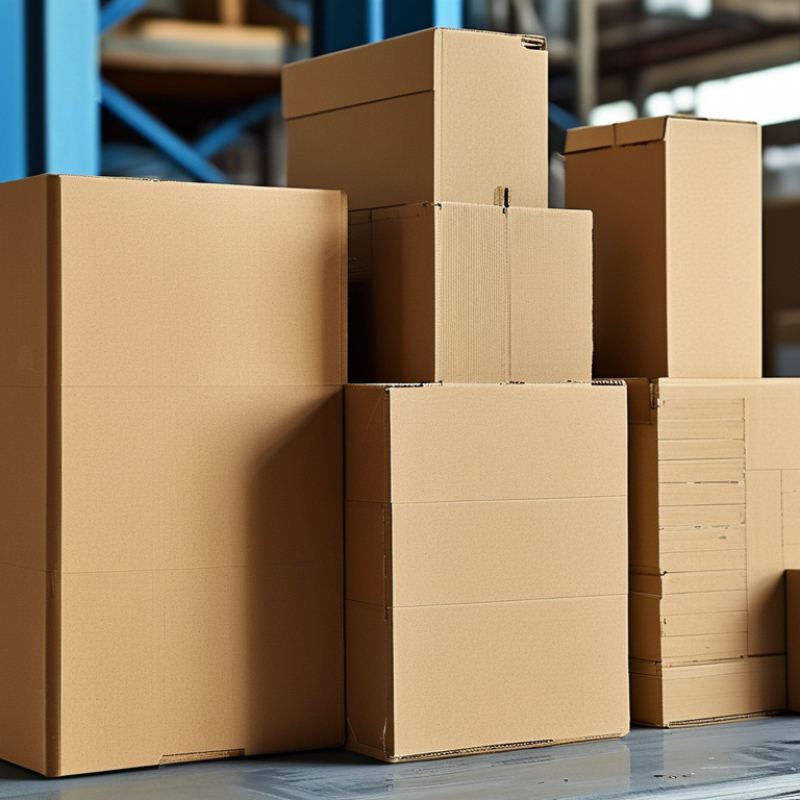
Industrial Cardboard: Definition, Functions, and Core Material Types
Industrial Cardboard: Definition, Functions, and Core Material Types
Industrial cardboard is a strong paper-based material used for packaging, separation, protection, and temporary structures. Unlike ordinary carton board, it must handle heavier loads, repeated movement, or harsher warehouse conditions. Its performance depends on fiber quality, thickness, moisture tolerance, and edge crush strength.
The main type is corrugated cardboard, made with flat liners and a fluted inner layer. Single-wall board suits lighter shipments, while double-wall and triple-wall structures support heavier equipment. Solid fiberboard offers a dense, smooth surface for partitions and protective panels. Honeycomb cardboard uses a cell-shaped core, giving impressive stiffness with low weight. It can protect machinery during transport, although exposed moisture may weaken it quickly.
In real packaging projects, selecting the thickest board is not always sensible. Extra material can increase cost, storage space, and handling effort. A better choice considers product weight, stacking height, vibration, humidity, and transport distance. I have seen packaging fail because teams measured weight but ignored sharp corners. That mistake is easy to repeat.
Tips: Check the edge crush test, burst strength, and board thickness together. Add corner protection for concentrated loads. Use moisture-resistant treatment for cold or humid storage. Test a packed sample before large production. Small trials reveal weaknesses that specifications sometimes hide.
What Is the Best Industrial Cardboard Type in 2026? — Industrial Cardboard: Definition, Functions, and Core Material Types
The best industrial cardboard type depends on load strength, moisture exposure, print quality, cushioning requirements, sustainability targets, and total packaging cost. The comparison below summarizes commonly used industrial cardboard structures and typical performance ranges.
| Industrial Cardboard Type | Basic Structure | Typical Basis Weight | Primary Functions | Strength and Protection | Moisture Performance | Printability and Surface Quality | Best-Fit Applications | Relative Cost | Overall Suitability |
|---|---|---|---|---|---|---|---|---|---|
| Single-Wall Corrugated Board | One fluted paper medium bonded between two liner sheets. | Approximately 250–600 g/m², depending on liners and flute profile. | Lightweight packaging, stacking, product separation, and basic impact protection. | Good compression and puncture resistance for light- to medium-duty shipments; performance depends strongly on flute height and liner quality. | Limited unless treated with moisture-resistant coatings, sizing, or water-resistant adhesives. | Good for flexographic printing; coated liners provide a smoother appearance. | Retail cartons, parcel shipping boxes, food cases, and general industrial packaging. | Low to medium | ★★★★☆ |
| Double-Wall Corrugated Board | Two fluted mediums separated by an additional liner and covered by outer liners. | Approximately 500–1,000 g/m². | Heavy-duty shipping, stacking, cushioning, and dimensional stability. | Higher edge-crush strength, stacking strength, and puncture resistance than single-wall board. | Moderate in standard form; enhanced grades are available for humid or chilled environments. | Suitable for industrial graphics, although the surface may be less smooth than folding carton board. | Appliances, machinery parts, bulk goods, export shipping, and warehouse pallets. | Medium | ★★★★★ |
| Triple-Wall Corrugated Board | Three fluted mediums combined with four liner layers. | Approximately 900–1,600 g/m². | Very heavy-duty protection, structural support, and replacement of some wooden containers. | Very high stacking, compression, and puncture resistance; suitable for large and heavy products. | Standard grades have limited moisture resistance; coatings and treated liners improve performance. | Functional rather than premium; printing is generally used for handling or logistics information. | Large industrial components, automotive parts, heavy equipment, and reusable transit packs. | Medium to high | ★★★★★ |
| Solid Bleached or Unbleached Fiberboard | Dense, multi-ply paperboard made from virgin chemical pulp or a combination of fiber grades. | Approximately 300–800 g/m². | Rigid packaging, die-cut structures, product presentation, and surface protection. | High stiffness and smoothness; less cushioning and shock absorption than corrugated board. | Usually limited without barrier coatings or laminations. | Excellent smoothness, color reproduction, folding, creasing, and die-cutting performance. | Industrial retail packs, premium components, medical packaging, and printed cartons. | Medium to high | ★★★★☆ |
| Coated Recycled Paperboard | Multi-ply paperboard manufactured primarily from recovered paper fibers, often with a coated top surface. | Approximately 350–700 g/m². | Cost-efficient rigidity, folding-carton production, dividers, and secondary packaging. | Good stiffness for moderate loads; generally lower moisture and tear resistance than virgin-fiber grades. | Limited to moderate; moisture barriers may be added when required. | Good to very good on the coated side; suitable for standard graphics and product information. | Consumer goods cartons, hardware packaging, separators, and non-food industrial packs. | Low to medium | ★★★★☆ |
| Kraftliner-Based Corrugated Board | Corrugated board using a high proportion of strong kraft liner on the outer or structural layers. | Approximately 300–900 g/m² for single- and double-wall constructions. | High load-bearing capacity, stacking, edge protection, and demanding transport conditions. | High tensile strength and good resistance to edge crush and bursting, particularly in heavier grades. | Moderate in untreated form; wax, coating, sizing, and adhesive selection can improve resistance. | Good for logistics printing and adequate for branded graphics; surface quality varies by liner finish. | Export cases, heavy products, high-stack warehouses, and long-distance distribution. | Medium to high | ★★★★★ |
| Honeycomb Paperboard | Paper honeycomb core laminated between flat liner sheets or paper facings. | Approximately 250–1,200 g/m², depending on core height and facing layers. | Blocking, bracing, edge protection, load distribution, and lightweight structural support. | High strength-to-weight ratio and good compression performance; less suitable for sharp impact without added facings. | Limited unless treated; exposed paper edges can absorb moisture. | Generally functional; surfaces can be laminated or covered for improved appearance. | Pallet decks, corner protectors, furniture packaging, panel cores, and void filling. | Medium | ★★★★☆ |
| Wet-Strength Paperboard | Paperboard treated with wet-strength resins, protective sizing, or barrier coatings. | Approximately 300–900 g/m², depending on the base board and construction. | Packaging and handling where temporary exposure to water, condensation, or high humidity is expected. | Maintains a greater proportion of its dry strength after wetting than untreated paperboard. | Good to very good, although performance depends on coating coverage, exposure time, and water temperature. | Good when the treatment is compatible with the required printing and converting process. | Cold-chain cases, produce packaging, outdoor logistics, and humid warehouse environments. | Medium to high | ★★★★☆ |
| Barrier-Coated Cardboard | Paperboard with a polymer, dispersion, wax, mineral, or other functional barrier layer. | Approximately 300–900 g/m², excluding or including coating weight depending on specification. | Resistance to moisture, grease, oil, oxygen, aroma transfer, or product migration. | Mechanical strength is determined mainly by the underlying paperboard structure. | Good to excellent for the targeted barrier; no single coating protects equally against all liquids and vapors. | Usually good, but coating chemistry can affect ink adhesion, scoring, sealing, and recyclability. | Food-contact packaging, chemical products, chilled goods, and moisture-sensitive components. | Medium to high | ★★★★☆ |
| Molded Fiber Packaging | Three-dimensional packaging formed from recycled paper fiber, virgin pulp, or mixed cellulose fiber. | Typically 500–2,000 g/m², depending on wall thickness and molded geometry. | Custom cushioning, product positioning, vibration control, and replacement of some plastic inserts. | Good compression and shape retention when properly designed; impact performance depends on geometry and wall thickness. | Low to moderate without treatment; coatings can improve water and oil resistance. | Natural textured appearance; suitable for molded details and limited surface printing. | Protective inserts, electronics components, industrial parts, and sustainability-focused packaging. | Medium to high | ★★★★☆ |
Note: Basis-weight and performance figures are typical industry ranges rather than universal specifications. Actual results vary with fiber composition, flute profile, liner combination, coating, moisture content, converting method, product geometry, and test conditions.
Related Posts
-
Why Choose Industrial Cardboard for Your Packaging Needs?
-
Top Industrial Cardboard Manufacturers for Global Buyers
-

Why Industrial Cardboard is Essential for Sustainable Packaging Solutions?
-
2026 Best Industrial Cardboard Options for Sustainable Packaging Solutions?
-
Understanding Cardboard Cores Their Uses Benefits and Applications
-
Top 10 Best Printed Cardboard Options for Global Buyers?
© 2025 Cardboard Tubes | Registered in England and Wales.
Company Number 2402078